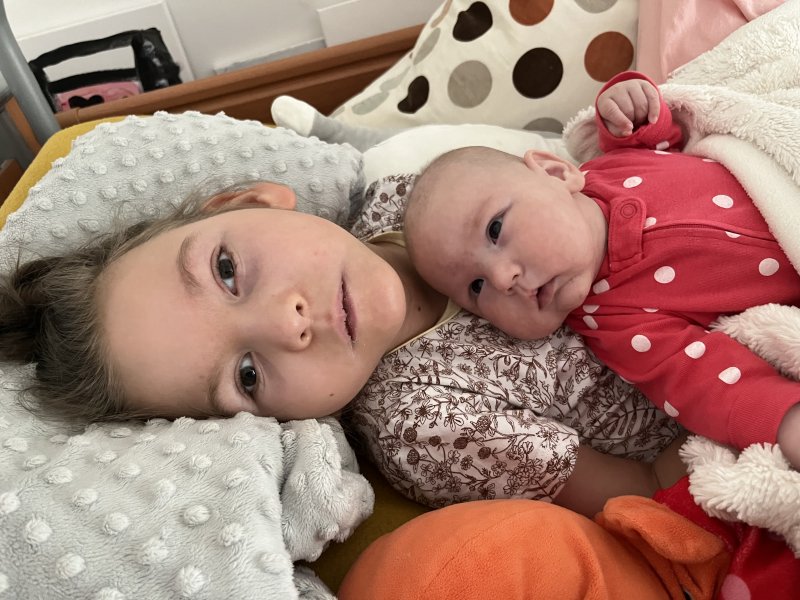
After some time, she was admitted to the Department of Pediatric Neurology, where she underwent a series of examinations, including magnetic resonance imaging (MRI). The MRI revealed severe damage to the brain's white matter. Despite extensive investigations, no definitive diagnosis could be established, and we were discharged home with a suspected diagnosis of hypoxic-ischaemic brain injury.
Developmental delays soon became apparent in virtually all areas. Thea had marked hypotonia, was unable to fix her gaze, showed little interest in her surroundings, could not lift or control her head, and was unable to achieve expected developmental milestones. At one year of age, her psychomotor development was still comparable to that of an infant in the first trimester of life, and this remains the case today.
Genetic testing initially failed to identify the underlying cause. Despite all our efforts, Thea's condition did not improve. On the contrary, her health gradually deteriorated—she began to lose previously acquired skills, and infections became increasingly frequent. However, we still did not know the definitive diagnosis.
In 2025, our second daughter, Sara, was born. Her health problems became apparent as early as the second day after birth. Events then unfolded rapidly, and doctors began investigating a possible connection between the medical conditions of our two daughters. Thanks to the care of Katerina Slaba, M.D., and the BabyFox project, carried out within the Centre for Precision Medicine at Brno University Hospital, a diagnosis of Aicardi–Goutières syndrome type 1 (AGS1) was established within just a few days. The same diagnosis was subsequently confirmed in Thea.
Receiving the diagnosis has finally given us an understanding of what to expect. We now know that AGS1 is a progressive disorder in which patients' health gradually deteriorates and the prognosis is poor. For this reason, both of our daughters are now under the care of a pediatric palliative care team.
Parents of Thea and Sara