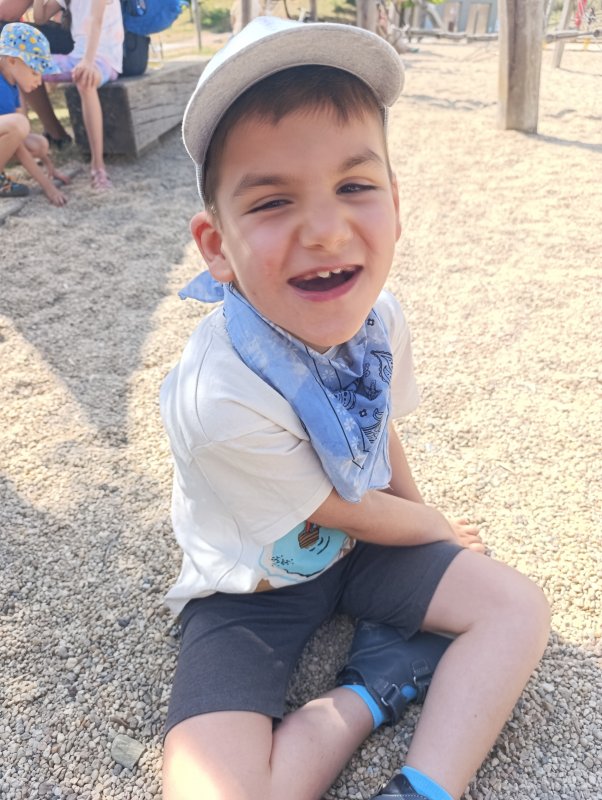
When Jirik was around ten months old, we were told that he would likely never be able to sit or walk independently. Our family made the difficult decision to invest all the money we had saved for our own home into supporting his lifelong fight. Since he was ten months old, we have been actively seeking every possible way to help him. Jirik has undergone intensive rehabilitation in specialized centers throughout the Czech Republic and Slovakia, including Vojta and Bobath therapy. He has also undergone countless medical examinations—from genetic testing and neurological assessments to ophthalmological evaluations.
At the age of two and a half, Jirik began suffering from febrile seizures whenever he developed symptoms of a common cold. Every illness in our household resulted in another hospital stay. This happened repeatedly until one day he experienced a seizure lasting nearly an hour. Nothing seemed to help, and he stopped breathing. During his hospitalization at the Children's Hospital of the University Hospital Brno, doctors managed to stabilize his life-threatening condition with medication.
Despite extensive testing, we still had no answers. No one could explain the cause of Jirik's condition. It was an incredibly difficult period filled with fear, uncertainty, and helplessness.
Even so, we never gave up. We continued fighting, attending rehabilitation sessions, and trying every possible treatment, hoping that one day we would finally understand what was happening.
Over time, the individual pieces of the puzzle slowly began to fit together. As a newborn, Jirik did not make eye contact, could not grasp objects, and was unusually lethargic. Most likely due to complications related to his birth, nerve signals were not being transmitted properly to his brain. He showed no interest in feeding and gradually became malnourished. At that time, we had no idea why all of this was happening.
It took years before we finally began to understand the true cause. We focused on his cervical spine, which had already become severely stiff. Every movement and every attempt to restore proper alignment of his vertebrae caused him significant pain. We hoped that improving blood flow and oxygen supply to his brain, along with restoring proper nerve signaling, might improve his condition. Sadly, we eventually had to accept that his brain had already been affected and that these changes were irreversible.
Despite all the care and effort, Jiřík gradually developed kyphosis—an abnormal curvature of the spine caused by spinal instability. Today, this spinal deformity has become part of his everyday life. It has also led to additional complications, including changes in his lumbar spine, chronic back pain, muscle fatigue, and stiffness. The kyphosis has also affected his breathing by limiting the function of his diaphragm.
In 2024, Jirik was referred once again to the Children's Hospital at University Hospital Brno, where he was evaluated at the Outpatient Clinic for Undiagnosed Pediatric Patients under the care of Katerina Slaba, M.D. After years of uncertainty, doctors finally identified the underlying cause of his condition—a mutation in the FBXW7 gene.
This extremely rare genetic disorder affects only a handful of individuals worldwide, and Jirik is currently the only known patient diagnosed with FBXW7 syndrome in the Czech Republic.
Although medical science continues to advance, there is currently no cure for this genetic condition. The only option is to manage its symptoms and work continuously to preserve Jirik's abilities and quality of life through intensive rehabilitation and ongoing specialized care.